Project Partners
Below are the project partners that aided in the recruitment and ethics for this research with their descriptions taken from their websites/relevant web pages.
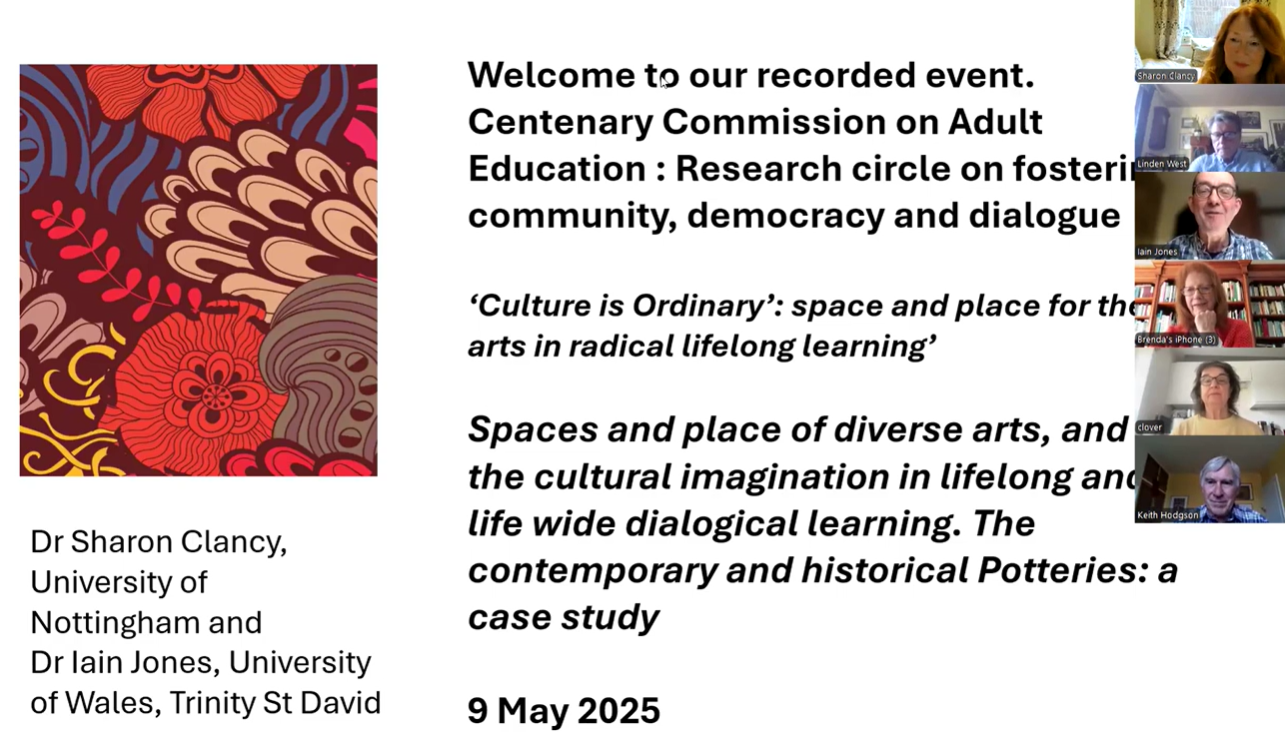 Research Circle on Fostering Community Democracy and Dialogue
Founded: 2020
Full Research Circle Video Playlist: https://www.youtube.com/playlist?list=PLw8qBNDC_ODfT_Xe5sPSoei7_q34KV01O
Description: In 2018, a group of adult educators, recognising the historic importance of the 1919 Ministry of Reconstruction Adult Education Committee’s Final Report, set up the Adult Education 100 campaign. The campaign sought to encourage a programme of activities, centred on the centenary of the 1919 Report, which would both recover and re-evaluate the twentieth-century history of adult education, and set out a vision for life-wide adult lifelong education for the 21st century through their report in the face of ongoing cuts to adult and community education, across the board. This is starkly exemplified by the number of part-time and mature students aged 17–60 in England who previously attended Higher Education institutions, many through extra mural and continuing education routes, having halved in a decade: from 96,575 in 2006/07 to 44,110 in 2016/17 (Department for Education, 2017, p.7).
Of all the themes emerging from the Report, ‘Fostering community, democracy and dialogue’ caught people’s imagination, practitioners and academics alike, and the Research Circle on this theme began to meet from September 2020 onwards. The Circle is made up of around 10 active members, drawn from backgrounds in adult, further and higher education, the voluntary and community sector and trade union education. All in the Circle have a deep commitment to social purpose education and their objective has been the sharing of experience and critical engagement, designed to explore and generate new and existing forms of practice in the generation of hope. The group has worked on a range of activities, including collecting resources/documents to support our Research Circle and the creation of background papers for their events.
UALL and SCUTREA

Universities Association of Lifelong Learning (UALL)
Founded: 1947
Description: UALL seeks to champion the broader definition of lifelong engagement with universities through part-time flexible provision offering personal, community and vocational development. It does so through advocacy in policy development, dissemination of information on policy, practice and funding through a lively programme of events, and through research and publication. UALL is structured to respond to change in higher education.
UALL is a membership subscription organisation, a registered UK charity, and is governed by a formal constitution. Each member institution nominates one or more individuals to the Council, the primary voting and decision-making body. The Executive Committee assists the Council in preparation and prioritising of agendas.

Standing Committee for Teaching and Research in the Education of Adults (SCUTREA) (Now Merged with UALL)
Founded: 1970
Description: SCUTREA are a welcoming professional network of international researchers, practitioners and scholars who recognise the importance of adult education as a tool for social change.
SCUTREA was established in 1970 with the membership initially drawn from university adult education departments throughout the United Kingdom. They hold a three day conference each year. Past conference papers can be found in their Archives, a collection assembled by Professor Bonnie Slade of the University of Glasgow. These historical documents showcase the work of noted contributors from adult education who were active in SCUTREA. The archives show how the chosen themes reflected current debates in adult education, with the format of the conference designed to reflect innovative adult education practice.
In their 50+ years of history, membership of SCUTREA has included the active participation of leaders in the field. SCUTREA values and celebrates the contribution made by long-standing participants, as well as those who have served (in a voluntary capacity) as officers of SCUTREA.
In 2024 they officially merged with UALL, joining together on a shared mission. They are a Standing Committee within UALL and no longer a stand-alone charity.
 Centenary Commission on Adult Education
Founded: 2018
Description: Centenary Commission have taken the words from the 1919 Report as the vision for their Centenary Report. They believe that ‘universal and lifelong’ access to adult education and learning is as necessary now as it was in rebuilding our society in the aftermath of the War to End All Wars.
What do they mean by ‘adult education and learning’? The United Nations Educational, Scientific and Cultural Organisation UNESCO defines lifelong learning like this:
"The integration of learning and living, covering learning activities for people of all ages (at home, at school, in the workplace, in the community, etc.) through formal, non-formal and informal modalities, which together meet a wide range of learning needs and demands."
The Sustainable Development Goal 4 clarified its focus as:
"to complement and supplement formal schooling, broad and flexible lifelong learning opportunities should be provided through non-formal pathways with adequate resources and mechanisms and through stimulating informal learning, including through use of ICT."
Since the mid-twentieth century, a succession of educational reforms have created a system of full-time, compulsory education for all, from the ages of 5 to 18, and 50% of our young people now go on to university. Much of the provision is outstanding. For many, the route to the learning they want or need is clear, as they move through formal, compulsory schooling into post-18 learning in Further Education colleges, universities, apprenticeships or employment.
There are others for whom the route is less clear, whose formal education has been disrupted, or who go through some transition in their lives or careers that calls for new skills or understanding. Young people leaving school without basic skills, new arrivals in the country who need support in becoming fully integrated citizens, those whose jobs are insecure or disappearing, those leaving prison or care – all should have their needs met. There are all too many who, for whatever reason, fall through the gaps or whose needs at work or at home are not met as they face new challenges or opportunities in life.
 Nottingham University
Founded: 1881 (as a University College) and then 1948 (when it received it's Royal Charter to become an independent University)
Description: The University of Nottingham was founded on the vision and philanthropic spirit of Jesse Boot who, in 1928, donated the land that is now University Park. The vision of a university devoted to discovery, enterprise and the advancement of the human condition, combined with his lifelong commitment to improving health and wellbeing, remains intrinsic to the culture of the University today and will continue to underpin our future purpose.
Their vision is to be a university without borders, where we embrace the opportunities presented by a changing world, and where ambitious people and a creative culture will enable us to change the world for the better.